
Dr Philippe Collin
Orthopaedic surgeon, shoulder specialist, Paris 16 & Neuilly-sur-Seine
Former President of the SECEC · ranked best shoulder surgeon in Paris (Le Point) · 20,000+ shoulders operated · 130+ scientific publications
Shoulder osteoarthritis, also known as omarthrosis, is a joint disease that leads to the destruction of the joint between the shoulder blade and the humerus. It follows the progressive wear of the cartilage, which causes pain and loss of shoulder movement.
Omarthrosis means osteoarthritis of the shoulder, and the whole joint is involved. The cartilage that covers the bones renews itself continuously. Osteoarthritis occurs when this process is disturbed and the cartilage eventually disappears. The role of this layer is to allow the joint surfaces to glide painlessly, which is what makes shoulder movement possible. As it degenerates, the innervated bone surfaces rub against each other, which is painful, and bony outgrowths called osteophytes develop.
Shoulder osteoarthritis is disabling because it has a strong impact on upper limb function. Women are generally the most affected. One or both shoulders may be involved, sometimes to different degrees.
There are two types of shoulder osteoarthritis, depending on whether the tendons are still present:
The main symptom of shoulder osteoarthritis is pain. It usually comes with a loss of mobility, for example being unable to raise the arm or to place a hand behind the back. The pain is triggered when the shoulder is moved, and it can also cause very disabling night pain that wakes patients frequently.
Cartilage wear does not happen suddenly, it is a gradual process. In the early stages the symptoms of shoulder osteoarthritis are not easy to identify and the condition is generally well tolerated. At that point patients feel intermittent pain caused by inflammation, and may also experience temporary blocking of the shoulder and a sensation of grinding. Pain on movement and progressive stiffening of the joint then appear.
As shoulder osteoarthritis progresses, pain usually becomes daily. Patients may stop moving the shoulder altogether, which leads to functional loss of the joint.
Daily pain and the risk of losing shoulder function justify a consultation as soon as the first symptoms appear. Patients can start with their general practitioner or with a rheumatologist. These doctors can diagnose shoulder osteoarthritis and begin medical treatment. If surgery becomes necessary, an orthopaedic surgeon specialising in the shoulder should then be consulted.
Orthopaedics is the medical speciality dedicated to conditions of the bones, joints, muscles, tendons and nerves. It covers several branches and roles, and its purpose is to diagnose and treat injuries of these structures. Some surgeons specialise in a single joint or in sports injuries.
The cause depends on the type of osteoarthritis. In centred osteoarthritis the cause is primary, which means that no specific cause is identified: the condition may simply be the natural consequence of joint ageing. In this situation the tendons are usually preserved.
Osteoarthritis is described as secondary when it follows a tear of the shoulder tendons, that is to say of the rotator cuff, or repeated dislocations. It can also result from multiple fractures, from an infection or from a rheumatic disease. The rotator cuff is the fibrous ending that connects the muscles to the bones. When it fails, the shoulder becomes unbalanced, which is what is known as eccentric osteoarthritis.
The specialist begins with a clinical examination, reviewing the symptoms and the pain described by the patient, since several signs point towards osteoarthritis of the shoulder. The clinical examination is then completed by further tests that confirm or rule out the diagnosis.
A standard X-ray assessment is used to establish the diagnosis and to visualise the bones of the shoulder, with front and lateral views. Several signs are looked for: abnormal narrowing of the space between the bones of the joint, a humeral head that has lost its spherical shape, or extra bone on the humeral head. These images also show whether the osteoarthritis is centred or eccentric.
An MRI scan or a CT arthrogram can be added to assess the state of the rotator cuff and the available bone stock, in anticipation of a possible shoulder replacement. The purpose of these additional examinations is to determine the best treatment for the patient. If the osteoarthritis is already advanced, the surgeon may decide to move directly to surgery and to a shoulder replacement.
Treatment usually starts with medication and rehabilitation, sometimes combined with injections.
In centred osteoarthritis the tendons must be monitored closely. This avoids having to treat the condition later, at the stage of a tendon tear, when the results are less satisfactory.
Over time these treatments lose their effectiveness and surgery may become necessary. Several options are available.
The first option consists of removing loose bodies and treating lesions of the biceps (arthroscopic debridement). The inflamed joint lining can also be removed (synovectomy). Osteoarthritis cannot be cured completely, since worn cartilage cannot be fully restored. Treatment aims to limit the wear of the cartilage and to relieve pain.
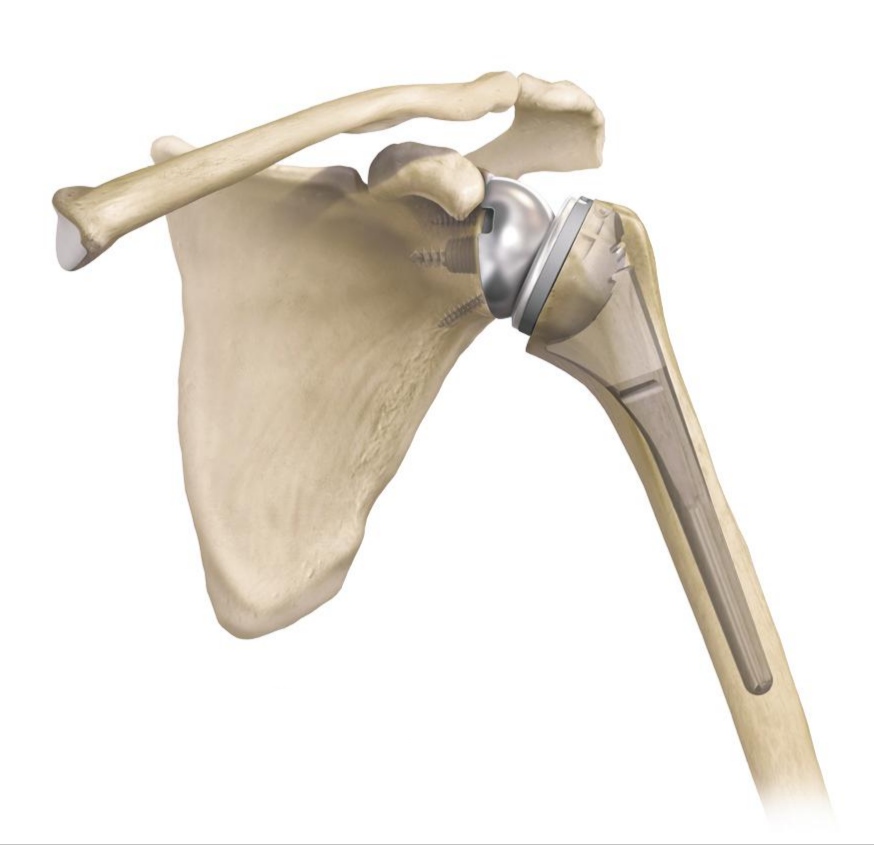
The second option is a shoulder replacement. Total shoulder replacements remain functional in 90% of cases, with a strong impact on pain and mobility. For eccentric osteoarthritis, a different type of implant is used. The operation is not without risks, although these are rare: a haematoma, incomplete recovery of shoulder range of motion, or a postoperative fracture. There is also a risk of infection, which remains exceptional.
The aim after a shoulder replacement is that the patient should no longer feel the implant. Immobilisation afterwards is more or less strict depending on the type of prosthesis. Rehabilitation begins very shortly after surgery. Daily activities are usually resumed around two months after the operation. Returning to sport is possible and most patients go back to the sport they practised before. The best approach is to agree with the surgeon on the right time to do so.
Shoulder osteoarthritis progresses fairly slowly, with inflammatory flare-ups that increase the pain. Without treatment, these episodes can become more and more frequent and severely disabling.
Dr Philippe Collin consults in Paris 16 and Neuilly-sur-Seine, and welcomes international patients. Discover the international patient pathway.






.svg)
.svg)